

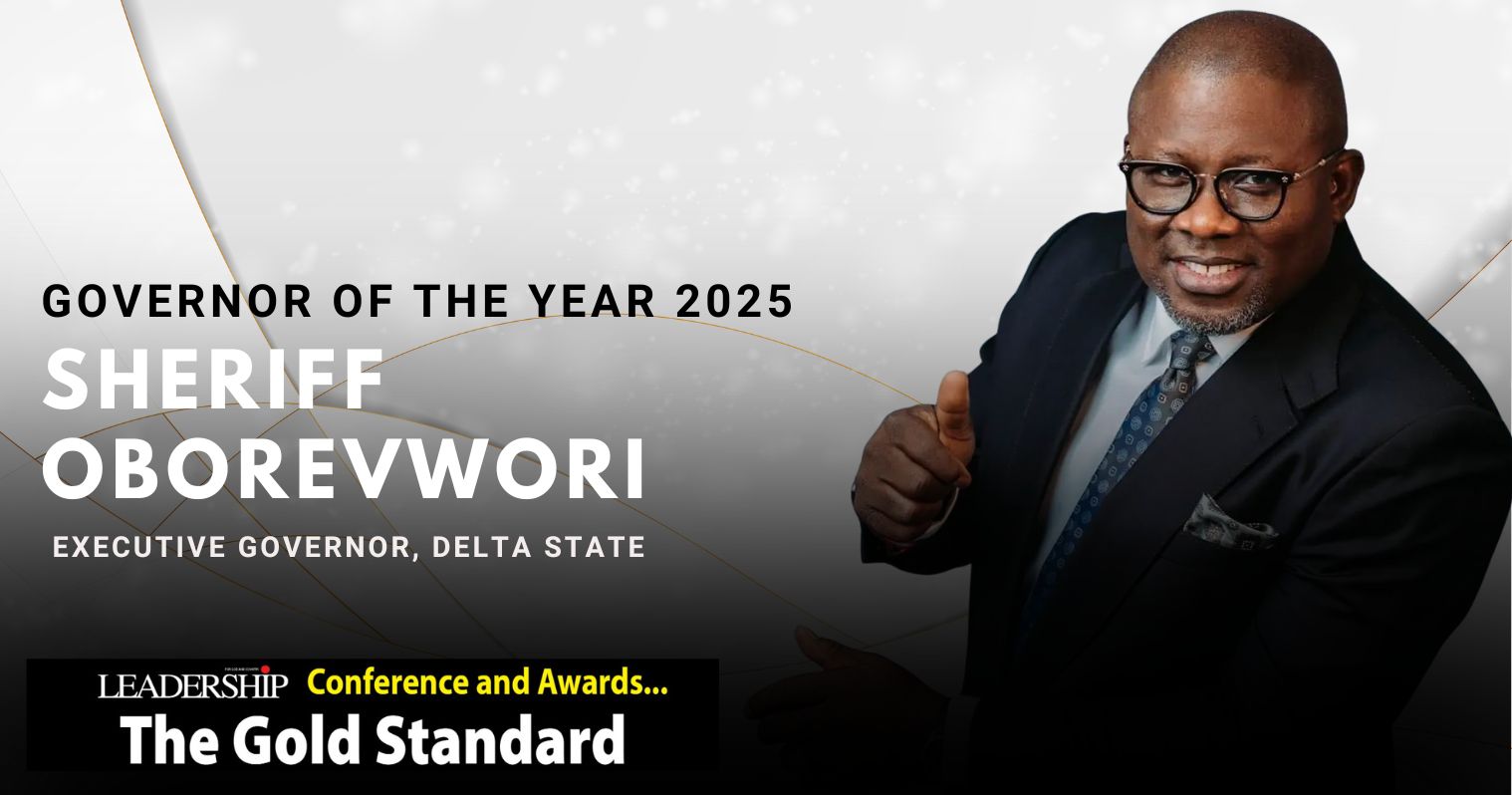
For his visionary “MORE Agenda” which has transformed Delta State through massive infrastructural renewal, improved education and healthcare, youth and women empowerment, fiscal discipline, peace and security, together with inclusive governance that prioritizes development, transparency, equity and opportunities for all Deltans, Governor Sheriff Oborevwori is LEADERSHIP Governor of the Year.
At the inception of his administration on May 29, 2023, Governor Sheriff Oborevwori was very clear on his vision to consolidate on the laudable milestones of his predecessor Arthur Ifeanyi Okowa, even as he was poised to break new grounds. This determination is captured in his “MORE Agenda” — MORE stands for Meaningful Development, Opportunities for all, Realistic Reforms, Enhanced Peace and Security.
Governor Sheriff Oborevwori, born June 19, 1963, previously served as speaker of the Delta State House of Assembly, representing the Okpe Constituency under the Peoples Democratic Party (PDP) from 2017 to 2023.
Since he assumed office, he has brought renewed energy to governance through a deliberate focus on infrastructural renewal and human capital development.
As Governor Oborevwori turned 62 on June 19, 2025, the people of Delta State celebrated not just the milestone of age but the enduring impact of a leader whose governance has brought transformation, hope and responsible leadership. He has proven himself a true people’s governor, distinguished by his unwavering passion for excellence, transparency and inclusive development.
His administration’s key reforms are focused on modernizing governance, improving social services (education and health), empowering youth and women, boosting infrastructure, and ensuring fiscal discipline, all within the framework of his “MORE Agenda”. These diverse reforms have, within the last two years, delivered meaningful development, created opportunities for all, triggered realistic reforms, and enhanced peace and security in Delta State.
Governor Oborevwori has prioritized completion of ongoing road projects, even as he has initiated new ones especially in urban and riverine areas. His urban renewal initiatives have brought about the upgrading of key towns like Warri, Effurun and Asaba, aiming to improve aesthetics and functionality. These are without prejudice to the administration’s transformative strides in several local government headquarters.
With over 513 road projects across the state spanning nearly 1,500 kilometres, bridges and flyovers, he has prioritized quality delivery. Key landmark projects such as the PTI Junction Flyover, DSC Roundabout Flyover, Enerhen Flyover, and the ongoing Sleepway at the Effurun Flyover, all being executed by Julius Berger, are not just physical structures but monuments to strategic planning and regional equity. These iconic projects are not concentrated in a single area but are spread across the three senatorial districts, demonstrating the governor’s commitment to equitable development.
Deltans are basking in the euphoria of improved connectivity between the state’s commercial city, Warri, and the seat of power, Asaba. In just two years in office, he has reduced travel time between the two most prominent centres of activity in the state by more than 30 minutes. What sets Oborevwori apart is not only his execution of capital projects but also the fiscal prudence with which they are delivered, budgetary discipline, and creative financing models such as project-specific ISPOs. This fiscal responsibility has earned him widespread commendation, including prestigious recognitions such as the Silverbird Governor of the Year 2023, ThisDay/Arise Governor of the Year 2024, and Vanguard Newspaper Governor of the Year (Infrastructure) 2024.
Oborevwori’s achievements go far beyond roads and bridges. His “MORE Agenda” has translated into tangible outcomes in education, healthcare, agriculture, and youth empowerment.
Governor Oborevwori has devoted both time and financial resources to education through infrastructure upgrade and capacity building. His investments in school infrastructure, teacher training, scholarships, renovation and construction of classroom blocks, science laboratories, and ICT centres in public schools, as well as the promotion of technical and vocational education through support for technical colleges and skills acquisition centres, have brought a new lease of life to the education sector in the state.
The governor has further strengthened the upgrade of technical colleges and established new vocational centres to give the youth practical skills relevant to the job market. For ICT training, the government introduced special programmes for digital literacy and computer skills, preparing youths for opportunities in the technology sector.
Further capacity building has brought about the engagement of over 2,500 teaching and non-teaching staff in public schools, while primary education has seen a further boost with the employment of 3,000 new staff. Tertiary education has also received attention, with improved infrastructure, salary reviews, and support for academic institutions across the state. More than ₦1 billion in bursaries has been disbursed to over 60,000 students, giving many youths a reason to stay in school and believe in a brighter future.
Healthcare initiatives under Governor Oborevwori have triggered the upgrade of primary healthcare centres and improved access to quality health services. Health insurance has been strengthened. Through targeted reforms, the Delta State Contributory Health Commission has been empowered to widen coverage, especially for vulnerable groups.
The administration has revamped primary health care centres by rehabilitating and equipping healthcare infrastructure across the state. Across the 25 local government areas, hospitals are being equipped with advanced diagnostic tools, including MRIs, CT scanners, and dialysis machines. With Governor Oborevwori’s provision of state-of-the-art dialysis machines and critical care infrastructure at the Asaba Specialist Hospital, the chief medical director, Dr Peace Ighosewe, recently announced that the hospital is now equipped to offer a wide range of renal replacement therapies, including SLED (Sustained Low Efficiency Dialysis) and Hemodiafiltration for both standard and ICU patients. “This is a major step forward in our commitment to providing world-class healthcare to the people of Delta State,” she stated.
These efforts are complemented by housing schemes and incentives for healthcare professionals, further strengthening the health system.
Social welfare interventions have, under his leadership, touched the most vulnerable. Through initiatives like Delta-CARES, over 250,000 citizens have received support, while targeted empowerment through the MORE Biz-Up scheme has offered lifelines to micro, small, and medium-sized enterprises. Farmers, artisans, women, the elderly, and persons living with disabilities have all benefited from a leadership that sees every citizen as part of the state’s growth story.
The administration has boosted youth and women empowerment through the expansion of the Delta State Micro, Small, and Medium Enterprises (MSME) support schemes, including grants and training for young entrepreneurs. Scaling up of the Youth Entrepreneurs Programme and skills training has enhanced human capital development. As part of efforts to give opportunities to all, Governor Oborevwori has ensured representation of various ethnic and political groups in appointments and resource allocation.
The administration is also taking advantage of the agriculture sector to empower Deltans by improving infrastructure, providing farm inputs, mechanization support, and access to credit to boost food production and rural livelihoods. The state government continues to support farmers through inputs, training and access to credit to enhance food security and job creation. Young farmers are grouped into clusters or cooperatives, making it easier to access government support, extension services and markets.
Sports and talent development are other key platforms the governor has deployed to empower the people. Oborevwori has been intentional in investing in sports programmes and facilities as well as promoting regular competitions to discover and nurture talents.
In governance reforms, Oborevwori has demonstrated both vision and agility. He restructured the Ministry of Works into Highways and Rural Roads divisions to increase focus and efficiency. He also launched digital budget tracking platforms, encouraged transparency and maintained regular engagement with the civil service. His administration commenced the payment of the new minimum wage of ₦77,500 to state workers at a time most sub-nationals in Nigeria were still contemplating how to engage with their workforce.
Governor Oborevwori’s commitment to promoting industrial harmony propelled him to facilitate the clearing of long-standing local government pension arrears by getting the state government to guarantee a ₦40 billion facility. The introduction of e-governance measures, including digitizing payroll and administrative processes to enhance transparency and reduce ghost workers, has repositioned the state civil service. Pension reforms have cleared the backlog of pension arrears and introduced more efficient pension payment systems for retirees.
Fiscal discipline and commitment to prudent management of state resources through transparency in budgeting have improved the state’s internally generated revenue.
Not content with local progress, Governor Oborevwori recently led a state delegation to China to explore avenues for international collaboration. The trip aimed to secure partnerships in infrastructure, technology, and particularly energy, aligning with his broader strategy of leveraging Delta’s natural gas reserves to attract investment, curb gas flaring, and create jobs through cleaner energy solutions. The journey reflects his openness to global partnerships and readiness to place Delta on the international investment map.
He has, in addition, invested in judicial reforms with the construction of a modern High Court Complex, the provision of vehicles to judicial officers, and housing for judicial staff, all of which enhance the independence and efficiency of the justice system.
In furtherance of enhanced peace and security, the Oborevwori administration has used dialogue and engagement with youth groups and stakeholders to address restiveness and ensure a stable environment for development. He has deepened dialogue with youth groups and traditional rulers, as part of measures to address communal tensions and youth restiveness. Support for security agencies through the provision of vehicles, equipment, logistics, and improved infrastructure has also helped to reduce crime and related violence.

