

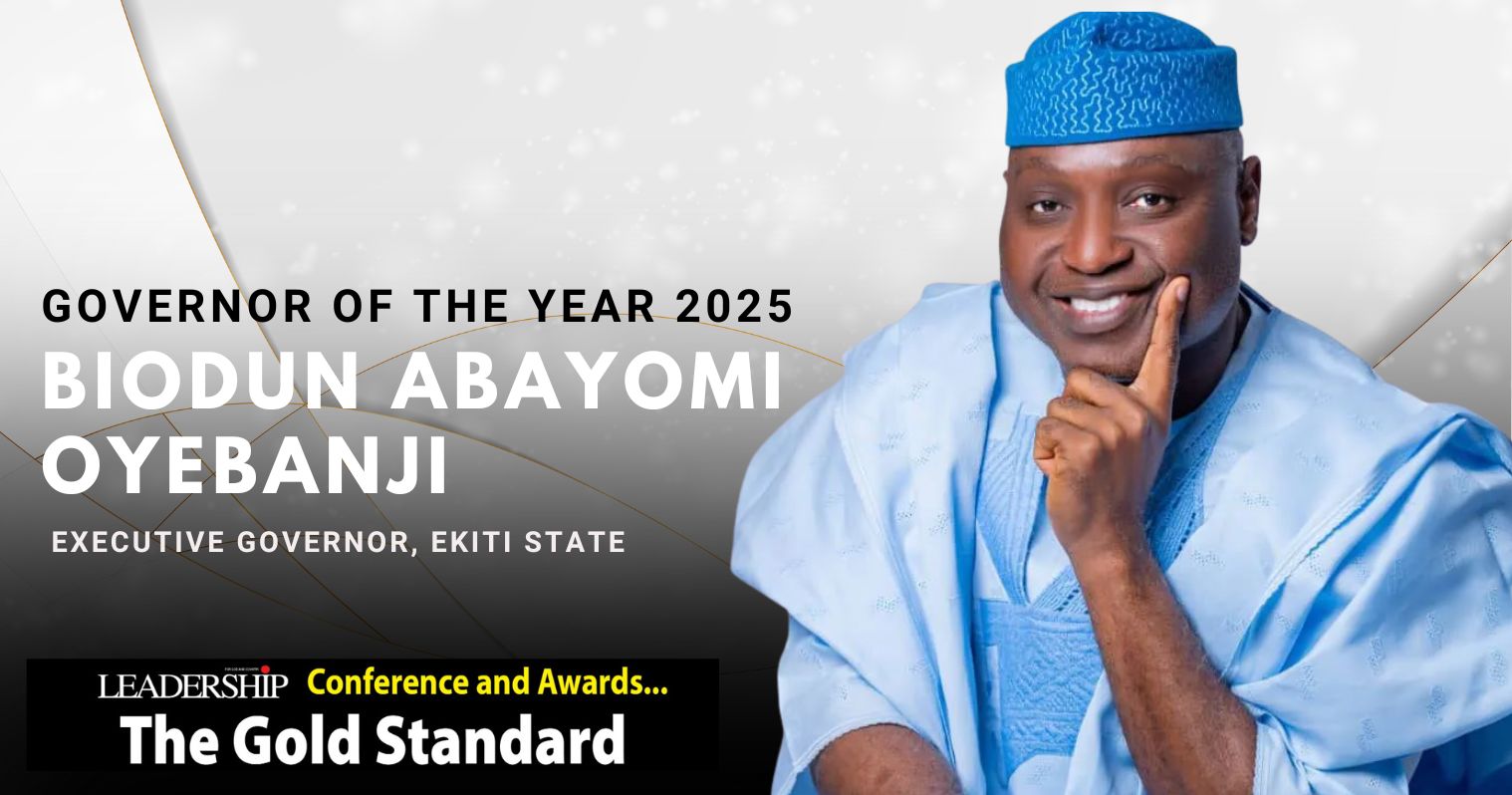
For his people-oriented leadership that has transformed Ekiti State through inclusive governance, leading to massive infrastructural renewal, youth empowerment and agricultural expansion in just three years; for completing over 368 major projects, engaging 5,000 youths in commercial farming, revitalizing education and healthcare, ensuring payment of pensions worth over N40 billion, and many other laudable achievements, Biodun Abayomi Oyebanji is LEADERSHIP Governor of the Year 2025.
Governor Oyebanji’s administration rests on six strategic pillars:
· Governance
· Youth Development and Job Creation
· Human Capital Development
· Agriculture and Rural Development
· Infrastructure and Industrialization, and
· Arts, Culture and Tourism
These pillars have guided policy direction, resource allocation, and project execution across all 16 local government areas of the state.
Within three years, the administration has completed over 368 major projects, with 209 others nearing completion (totaling 577 projects) spread across more than 200 towns and villages. These cover education, healthcare, infrastructure, agriculture, social investment, power, housing, and civil service reforms.
One of Oyebanji’s most remarkable achievements is his massive investment in infrastructure. His administration has completed several major road projects such as the Ikere–Igbara–Odo Road, Ogotun–Ikogosi Road, Isinbode–Ara–Ikole Road, Ado Ekiti Ring Road (Phase 1), and Omu–Ijelu–Itapa Road. Other key projects include the Spotless Hotel Road, GRA Third Extension Road, and ongoing construction of the Okeyinmi Flyover and Ekiti Ring Road Phase II.
He has also completed the Ekiti State International Cargo Airport, which has received commercial operation approval from the Nigerian Civil Aviation Authority (NCAA), positioning Ekiti as a logistics hub in the South-West. The government is also constructing the International Centre for Arts and Culture, an 80-bed multipurpose ward at the Ekiti State University Teaching Hospital (EKSUTH), and other flagship urban renewal projects that will transform Ado Ekiti and other major towns.
Governor Oyebanji’s agricultural reforms have redefined Ekiti’s economy. Over 5,000 youths have been engaged in commercial cluster farming across the state. The government has provided free land clearing, constructed dormitories at farm sites, and procured tractors and modern equipment at Oke Ako Farm Settlement to enhance productivity. Initiatives like the Broilers Scheme at Erifun Farm and the Bring Back Youth in Agriculture programme have boosted food security and job creation.
The governor also recruited 400 Amotekun operatives and agro-marshals to support community security and protect farmlands.
Recognizing education as the bedrock of progress, Governor Oyebanji increased the monthly subvention to state-owned tertiary institutions from ₦767.8 million to ₦1.27 billion, ensuring regular payment of salaries and improved facilities. Across the 16 LGAs, schools have been renovated — with new classrooms, laboratories and administrative blocks. A Children’s Service Centre was established for children with disabilities, while 16 classrooms were upgraded with interactive smart boards for blended learning.
The administration also recruited 1,600 teachers and 200 non-teaching staff, ensuring improved teaching quality. His focus on digital literacy and vocational training has positioned Ekiti as a hub for future-ready youth.
Oyebanji’s leadership in the health sector is equally impressive. The EKSUTH Neonatal Intensive Care Unit and Dialysis Centre were constructed and renovated. An 80-bed multipurpose medical complex is under construction at EKSUTH, and five general hospitals in Oye, Ijan, and Ifaki Ekiti have been comprehensively rehabilitated and equipped with modern facilities.
Through the Ekiti State Health Insurance Scheme, 19,000 pensioners now enjoy free healthcare services. Over 3,700 free surgeries were conducted for indigent patients. After more than 600,000 malaria tests, 500,000 free malaria drugs (ACT) were distributed statewide. The Basic Health Care Provision Fund (BHCPF) programme has also provided essential health services for people with disabilities, HIV patients, and the elderly.
To strengthen service delivery, 250 healthcare professionals — including doctors, nurses, and community health officers — have been employed.
Governor Oyebanji’s social inclusion programmes target vulnerable groups. His government renovated the Transit Home for Abused Women and Girls in Ado Ekiti, empowered persons with disabilities (PWDs) with vocational tools, and provided hearing aids for the hearing impaired.
Under the Water, Sanitation, and Hygiene (WASH) initiative, the government paid over ₦300 million compensation to property owners affected by flood channel expansion at Atikankan in Ado Ekiti. Massive desilting and drainage projects were carried out across the state to prevent flooding.
The Oyebanji administration has expanded power access through several projects: extension of 33KV line from Omisanjana transmission substation to Baptist High School, Ado Ekiti, and extension of Independent Power Plant (IPP) supply to NTA Ado Ekiti and Broadcasting Service of Ekiti State (BSES). These efforts have improved power reliability in public institutions and critical service points.
Governor Oyebanji is deeply committed to workers’ welfare. He introduced a free mass transit scheme for civil servants and students within Ado Ekiti. He cleared a backlog of pensions and gratuities — paying ₦4.9 billion to 2,260 pensioners, ₦1.3 billion to 348 retirees in Ado local government area, and over ₦40 billion across the state in three years.
Beyond physical projects, Oyebanji is widely respected for his humility, inclusiveness, and unifying leadership. He has built bridges across party lines, earning the support of all former Ekiti governors — Niyi Adebayo, Ayo Fayose, Segun Oni, and Kayode Fayemi — who commend his humility and commitment to the state’s development. Senate leader Opeyemi Bamidele also described him as “a man of rare grace and humility”. This political harmony has stabilized governance and strengthened Ekiti’s democratic culture.
Oyebanji has empowered thousands of youths through skill acquisition and innovation programmes. The government completed the Skill Acquisition Centre in Ado Ekiti, established the Aso-Oke Weaving and Market Centre, and is remodeling parts of the Oodua Textile Complex into a garment and fashion hub. In collaboration with SMEDAN, the state government has trained over 5,000 youths in financial literacy and business management, while 250 artisans have received Trade Test certificates to enhance their employability.
Born on December 21, 1967, in Ikogosi-Ekiti, Oyebanji is proudly homegrown. He attended schools across Ekiti and earned his B.Sc. in Political Science from Ondo State University (now EKSU) and a Master’s degree in International Relations from the University of Ibadan.
He served as a lecturer and a banker. One of the founding architects of Ekiti State’s creation, he was the secretary of the Committee for the Creation of Ekiti State in 1996. Now he has served over 11 years in public office.
Married to Dr. Olayemi Oyebanji, a senior lecturer at the University of Ibadan, they are blessed with three children.

